
Sensus Communis
Common Sense is more than a catchphrase; it's a legal and philosophical term of art with a rich history of substantive meaning dating to the founding of the United States.

Note: This article was originally planned for publication in a legal journal, and I have chosen to accelerate it for publication here. In the future, there will be more updated versions of this piece, so please check to make sure you’re using the most updated version before making any citations to the material contained herein.
This article will be the basis from which we build a new intellectual foundation. If you’re interested in building on these ideas further, please do so; much of our work remains incomplete, and we need many minds at work to reestablish a good understanding of the American Republic.
Sensus Communis
by S. Connor Cheadle
I. Introduction
The preamble of the Declaration of Independence reads: “When in the course of human events, it becomes necessary for one people to dissolve the political bands which have connected them with another, and to assume among the powers of the earth, the separate and equal station to which the laws of nature and of nature’s God entitle them, a decent respect to the opinions of mankind requires that they declare the causes which impel them to the separation.” The clause emphasized establishes the philosophical basis for the American legal system and the fundamental basis to which all American judges must be faithful if our Republic is to perpetuate American values, history, and tradition. The jurists of contemporary American law rarely turn to ground their works of the law in “the laws of nature and of nature’s God” despite the requirement “that they declare the causes with impel them” to their conclusion. Thus, our law, or our “opinions of mankind” are no longer privileged to be given a “decent respect.” In other words, our law is no longer anchored in its most fundamental source, the natural law; and we are now cast adrift, subject to the whimsical tyrannies of factional, if not outright ideological, interpretive methodologies.
Our legal system is founded on the natural law. Several methods of interpretation generally aim to effectuate the spirit of the natural law in our legal system—namely, originalism, through Thomas's 'Text, History, and Tradition', and textualism. Yet they all miss something, a lost term of art, sensus communis, or common sense. Common sense is the missing interpretive methodology needed to correctly divine fundamental rights in the Constitution. Common Sense is itself a legal term of art, the missing link in originalism. The phrase ‘common sense’ has become a cliché in the modern vernacular; nothing more than a reference to seemingly subjective, at best, or naïve, at worst, convictions of individual opinion. However, jurists and historians have been looking in the wrong place to find the scope of common sense. It comes not from English common law but from the Scottish bridge between the natural law and natural philosophy.
This paper argues that sensus communis, properly understood through its roots in the Scottish Enlightenment, which heavily influenced the American Founders, offers a robust, historically grounded interpretive methodology essential for navigating the challenges faced by modern originalism and textualism and for rediscovering the natural law foundation of American jurisprudence. Section II will delve into the prevailing interpretive methodologies of originalism and textualism, examining the contributions and challenges faced by key proponents like Justices Scalia and Thomas, and exploring the evolution through first and second-wave originalism towards a potential "Third Wave" focused on identifying relevant tradition. Section III will introduce sensus communis, tracing its origins to the Scottish Enlightenment and its profound impact on the American Revolution and the thinking of the Founding Fathers. It will define common sense as understood by philosophers like Thomas Reid and demonstrate its integration into the American legal framework by figures such as James Wilson, culminating in the proposal of a specific Sensus Communis Method for interpreting fundamental rights based on natural precepts and moral liberty.
II. Originalism, Textualism, and ___?
a. Scalia & Thomas
The late Justice Scalia was an ardent critic of the perceived failures of modern legal education. In his 2014 commencement speech to William & Mary Law School, he lamented, “Can someone really call himself an American lawyer who has that gap in his compendious knowledge of the law? And can a society that depends so much upon lawyers for shaping public perceptions and preserving American traditions regarding the freedom of speech and religion afford so ignorant a bar?”[1] Scalia believed that contemporary lawyers had lost the ability to interpret laws rigorously within their textual and historical context, a skill he thought was more prevalent among earlier generations of American lawyers.[2] He attributed this decline to a shift in focus away from traditional methods of legal interpretation toward more subjective or policy-driven approaches.[3]
Early in his career, Scalia appeared to have thought the failings of modern legal interpretation were attributable to a lack of focus and understanding of the common law.[4] For instance, in his fiery dissent in Rogers v. Tennessee, Scalia wrote, “At the time of the framing, common-law jurists believed (in the words of Sir Francis Bacon) that the judge's ‘office is jus dicere, and not jus dare; to interpret law, and not to make law, or give law.’”[5] Scalia echoed Marbury v. Madison by attempting to root the principle that “[i]t is emphatically the province and duty of the judicial department to say what the law is” on more solid ground for future interpretation.[6] He recognized that the distinction between jus dicere and jus dare was becoming increasingly more difficult for modern judges, lawyers, and minds to grasp and properly divine. In other words, he saw that common sense was no longer making sense.[7]
However, as his career progressed, Scalia himself lost faith in re-grounding interpretive methodology. While “Scalia’s early writings and opinions were more in keeping with the classical legal tradition, as explicated by Aristotle and Thomas Aquinas,” he “evolved” into a more rigid type of originalism and textualism, “resulting in American legal conservatism becoming increasingly focused on criticism and limitation of the administrative state.”[8] The old Scalia would have followed Thomas Aquinas, viewing the role of the judiciary as connecting the “lex, the positive written civil law” to the “ius, [the] general and traditional background principles of law writ large.”[9] The later Scalia, speaking to a conference of Dominican Friars, would go on to directly refute Aquinas: “Despite my veneration for St. Thomas Aquinas, I plan to contradict what Thomas Aquinas says about judging. It is necessary to judge by the written law, period.”[10] In his later years, the expansive vision that once characterized Scalia’s reliance on overarching legal principles to advance the common good had been confined to the mere dimensions of the text inscribed upon the pages of the law.[11] Scalia had become a full textualist, abandoning his faith in the English common law.
On the other hand, Justice Thomas has doubled down in his attempt to refine and further define originalism through his methodology applied to the Fourteenth Amendment, the Second Amendment, and, surprisingly, through standing doctrine. His concurrence in McDonald and his surprising, yet eloquently forceful dissent in TransUnion paint a picture of originalism esoteric to liberal and conservative minds alike.[12]
Thomas has continuously couched his efforts in the age-old conundrum caused by The Slaughterhouse Cases’ effective abrogation of the Privileges or Immunities Clause of the Fourteenth Amendment.[13] In McDonald v. City of Chicago, a plurality held that the Second Amendment right to keep and bear arms for self-defense, as recognized in District of Columbia v. Heller, is a fundamental right that applies to the states through the Fourteenth Amendment. The Court determined that this right is “deeply rooted in this Nation’s history and tradition” and “fundamental to our scheme of ordered liberty.”[14] As a result, state and local governments, like the city of Chicago and the village of Oak Park, cannot enact laws that effectively ban handgun possession by private citizens in their homes.[15] The majority reached this result primarily through the Due Process Clause of the Fourteenth Amendment, declining to revisit the narrow interpretation of the Privileges or Immunities Clause established by the Slaughter-House Cases.[16] As the plurality in McDonald so amply notes, the issue with the Fourteenth Amendment (as they see it) is that the proponents of the Privileges or Immunities Clause are “unable to identify the Clause’s full scope.”[17] Ironically, the Supreme Court eloquently demonstrated that lawyers have lost the skills necessary to identify, argue, and protect fundamental rights, as Scalia had warned.
Thomas concurred, but only to the outcome of the case. He sensed, correctly, that the Court has the whole construction of the Fourteenth Amendment and the Privileges or Immunities Clause backwards. Thomas points out that the extra step of having to divine a fundamental right through the constructs of substantive due process is not only “a legal fiction [but] a particularly dangerous one.”[18] First, “[t]he notion that a constitutional provision that guarantees only ‘process’ before a person is deprived of life, liberty, or property could define the substance of those rights strains credulity for even the most casual user of words.”[19] Second, and more importantly, “[t]he one theme that links the Court's substantive due process precedents together is their lack of a guiding principle to distinguish ‘fundamental’ rights that warrant protection from nonfundamental rights that do not.”[20]
Thomas goes on to make his case that the best way to interpret fundamental rights is through original public meaning, or the text, history, and tradition test that would develop out of Bruen; in essence, historic originalism at its finest.[21] However, while the debate over the Privileges or Immunities Clause and fundamental rights rages on all other fronts, few noticed that Thomas’s warning of dangerous implications arising from an unworkable substantive due process jurisprudence has already been realized in TransUnion.
TransUnion LLC v. Ramirez arose when Sergio Ramirez and a class of 8,185 people sued TransUnion, alleging that its credit reports falsely labeled them as potential matches to a government list of terrorists and serious criminals due to faulty name-matching procedures.[22] While all class members received letters about the OFAC alert, only 1,853 had their erroneous credit reports actually disseminated to third parties.[23] The Court, in a 5–4 decision, ruled that only those whose credit reports were shared with third parties suffered the kind of reputational or other concrete injury necessary for standing; the rest, whose reports were not disclosed, lacked standing because they suffered no concrete harm.[24]
The majority defined “concrete harm” for standing as an injury that is real and not abstract, requiring more than a mere statutory violation or a risk of future harm.[25] The Court explained that a harm is concrete if it has a “close relationship” to a harm that has traditionally been recognized as providing a basis for a lawsuit in American courts, such as physical, monetary, or reputational injury.[26] Intangible harms, like reputational damage or the disclosure of private information, can also qualify as concrete if they are closely related to harms recognized in common law.[27] However, the Court emphasized that the mere existence of inaccurate information in a credit file, without dissemination to a third party, or a mere risk of future harm that never materializes, does not amount to concrete harm.[28] Thus, only those plaintiffs who can show they suffered a real, traditionally cognizable injury, such as having their erroneous credit report shared with a third party, have standing to sue for damages in federal court.[29]
An odd set of bedfellows dissented. Justices Breyer, Sotomayor, and Kagan signed on to Thomas’s dissent.[30] He began by pointing out that, in a sister case against TransUnion, “the jury returned a verdict in the consumer's favor on four [] claims, two of which are similar to claims at issue here: (1) TransUnion failed to follow reasonable procedures that would ensure maximum possible accuracy, 15 U.S.C. § 1681e(b); and (2) TransUnion failed to provide [one of the appellees] all information in her file despite her requests, § 1681g(a).”[31] Following the verdict in that case, “TransUnion made surprisingly few changes” in its business practices, ultimately leading up to the events in Ramirez.[32]
Sergio Ramirez went to buy a car, but the dealership refused to complete the sale after a credit check indicated he was on a “terrorist list.”[33] Ramirez then requested his credit report from TransUnion, which appeared “complete and reliable” but did not mention the OFAC alert.[34] Later, TransUnion sent him a separate letter stating he was a potential match to the OFAC database, but this letter did not clarify that the alert was on his credit report and failed to include information about his rights under the Fair Credit Reporting Act or how to dispute the alert, instead directing him to contact TransUnion or the Treasury Department with questions.[35] Ramirez sued TransUnion for willfully failing to ensure the accuracy of his credit information, disclose all information in his file, and include a summary of rights in its correspondence, and he sought to represent a class of others who received similar OFAC letters with the same deficiencies.[36] Although the jury found in favor of Ramirez and his class, “TransUnion appealed, arguing that the class members lacked standing.”[37] The Ninth Circuit disagreed, stating that “TransUnion's reckless handling of OFAC information exposed every class member to a real risk of harm to their concrete privacy, reputational, and informational interests protected by the FCRA.”[38] The Supreme Court, however, overturned their ruling.
Thomas’s analysis begins by recounting that the power in Article III extends to “all Cases, in Law and Equity, arising under this Constitution . . . .”[39] Yet he summarizes Constitutional standing with a simple but overlooked preposition: “Key to the scope of the judicial power, then, is whether an individual asserts his or her own rights.”[40] Engaging in a text, history, and tradition style analysis, Thomas traces the historical understanding of standing, arguing that the Constitution has traditionally distinguished between public rights (which generally cannot be enforced by individuals) and private rights (which individuals have always been able to vindicate in court).[41] He contends that when Congress creates a private right and a cause of action, as it did in the FCRA, plaintiffs inherently have standing to sue for violations of those rights without needing to show additional harm.[42]
Thomas says the majority rejects the entire history of standing and “holds that the mere violation of a personal legal right is not—and never can be—an injury sufficient to establish standing.”[43] For the majority, the only thing that matters is that an “injury in fact be concrete.”[44] He continues, “[t]hat may be a pithy catchphrase, but . . . it was not until 1970—'180 years after the ratification of Article III’—that this Court even introduced the ‘injury in fact’ (as opposed to injury in law) concept of standing.”[45]
Here, the danger of fundamentally misunderstanding the operation of fundamental rights, as Thomas warned about in McDonald, creeps in. “The Court later took this statutory requirement and began to graft it onto its constitutional standing analysis.”[46] While “the historical restrictions on standing offer considerable guidance,” the majority “takes the road less traveled.”[47] The Court concludes that “an injury in law is not an injury in fact.”[48]
“No matter if the right is personal or if the legislature deems the right worthy of legal protection, legislatures are constitutionally unable to offer the protection of the federal courts for anything other than money, bodily integrity, and anything else that this Court thinks looks close enough to rights existing at common law. The 1970s injury-in-fact theory has now displaced the traditional gateway into federal courts.”[49]
Thomas posits hypotheticals to the unworkable standard the majority seems to have created in its ruling. If the kind of “confusing and frustrating communication” in the facts of TransUnion “is insufficient to establish a real injury, one wonders what could rise to that level. If, instead of falsely identifying Ramirez as a potential drug trafficker or terrorist, TransUnion had flagged him as a ‘potential’ child molester, would that alone still be insufficient to open the courthouse doors?”[50] Eerily similar to the inability of the Court to decern the scope of the Privileges or Immunities Clause, Thomas concludes in TransUnion, “if some of these examples do cause sufficiently ‘concrete’ and ‘real’—though ‘intangible’—harms, how do we go about picking and choosing which ones do and which do not? I see no way to engage in this ‘inescapably value-laden’ inquiry without it ‘devolv[ing] into [pure] policy judgment.’”[51] While standing, statutory rights, and fundamental and Constitutional rights are supposedly separate areas of the law, TransUnion demonstrates that the same line of thinking, namely, the inability to discern the scope of any right, is rampant among jurists, including five of the supposedly conservative/originalist justices of the Supreme Court.
Scalia turned to textualism and garnered a vast following of strict legalists adhering to the interpretation of the text and the text alone. On the other hand, Thomas has inspired further understanding the law as the Founders intended it. However, he does not know how to frame their interpretations and upon what basis to construct the original understanding. He struggles to define the same ‘common sense’ that Scalia struggled to define before Thomas’s time. Neither Scalia nor Thomas have been able to establish the self-evident fundamentality of the rights and liberties in the Constitution. Both Scalia and Thomas appear to have driven themselves in circles attempting to find the root of textualism and originalism, and the modern state of originalists and textualists reflects the dizzying interplay between followers of Scalia and followers of Thomas.
b. First and Second Wave Originalism
Jud Campbell, a law professor at Stanford, recently published an article detailing the divide between textualism and historical originalism (Campell defines both under a broader definition of ‘originalism’), positing that the old ‘general law’ could serve as the missing link between the two half-baked schools of thought.[52] Campbell begins by noting that tradition has become increasingly prominent in Supreme Court jurisprudence, especially among originalist justices, but its place within originalist theory is not obvious.[53] Many originalists are skeptical of relying on tradition because it appears to conflict with the idea that the Constitution’s meaning is fixed at the time of enactment, whereas traditions are, by nature, evolving.[54]
Campbell argues, however, that at the time of the Founding and Reconstruction, American legal elites recognized a body of “general fundamental law,” which included customary rights seen as fundamental across jurisdictions.[55] The Constitution, Bill of Rights, and Fourteenth Amendment were understood to recognize and secure these rights, not to create or fix them in constitutional text.[56] Instead, these rights are thought to preexist in customary law and could evolve over time.[57] Thus, the legal culture of the Founding era accepted that fundamental law could be partly constituted by tradition, not just by written texts.[58]
Campbell distinguishes between two methodological approaches within his broader definition of originalism.[59] “Track one” originalists use modern criteria to identify the content of past law, filtering historical facts through present-day jurisprudential standards.[60] “Track two” originalists, by contrast, use historical criteria, seeking to reconstruct law as it was actually understood at the time, including the Founders’ beliefs about the sources and methods of law.[61] This distinction is crucial because, under track two, tradition may play a significant role if it did so in the Founders’ legal system, potentially allowing for the evolution of constitutional content in line with historical practices.[62] Here, the difference between ‘Track one’ and ‘Track two’ originalists roughly map onto the difference between Scalia and Thomas. Scalia’s methods map more closely with ‘Track one’, and Thomas's with ‘Track two’. Even so, the terms ‘textualism’ and ‘originalism’ vary in meaning from jurist to jurist, only supporting the claim that neither method tends to be consistently reliable.
Campbell finds that the original understanding of American constitutional law allowed for fundamental rights to be grounded in tradition and custom, not just written texts.[63] He says, “We live in an ‘age of statutes.’ . . . Yet prior to the early twentieth century, . . . [American law] was an age of general law.”[64] The decline of general fundamental law in the twentieth century has left originalists with a methodological challenge: whether to interpret constitutional rights using present-day or historical criteria.[65] Yet both tracks have missed the point, in the tradition of American law, “[n]ot only [is] it a mistake to think of texts as the only source of law, it [is] also a mistake to think that textually enumerated rules necessarily obtained their force or content from their enumeration.”[66]
Both Track-one and Track-two originalists are stuck in their own respective loops as to how tradition should operate in interpreting fundamental rights.[67] For Track-one, “traditions cannot determine the content of the law unless modern criteria identify tradition as a source of fundamental law.”[68] Yet, for a system designed to require the judicial enumeration of the unenumerated, Track-one quickly runs short of modern criteria for determining the content of the law.[69] On the other hand, “track-two originalists believe that identifying the law of the past requires a deeper form of historical inquiry, locating how the Founders conceptualized their own law.”[70] Yet, Track-two becomes recursive because “what one learns when looking to the past is that American legal culture previously accepted that fundamental law was partly determined by evolving customs, and not merely by the fixed meaning of enacted texts.”[71]
As Campbell points out, “one might think that recognizing an evolving body of constitutional law is the essence of non-originalism.”[72] However, this issue could be solved, at least in part, by looking to the general fundamental law composed of both legal traditions and “the experiential traditions of the Founders.”[73] Campbell finds, “[i]n this way, ‘original meaning’ is not something that we just discover, like a coin on the sidewalk. Rather, it is something that an originalist must reconstruct, as best she can, by filtering historical evidence through some interpretive sieve.”[74] Though this additional step helps, “if an originalist is considering textually grounded fundamental law, she will still run into the same sorts of problems that divided originalists onto track one and track two. That is, an originalist will still have to make jurisprudential choices about how to identify the relevant tradition.”[75]
Here, even in applying general law principles, we run into the same problem that Scalia ran into in the middle of his career, and Thomas lamented over in TransUnion: “I see no way to engage in this ‘inescapably value-laden’ inquiry without it ‘devolv[ing] into [pure] policy judgment.’”[76] And it is here that the plurality in MacDonald threw up their hands and returned to couching their incorporation of the Second Amendment under substantive due process because they could identify no other means “to identify the [Privileges or Immunities] Clause’s full scope.”[77] In other words, Track-one and Track-two, Scalia and Thomas, cannot figure out how to discern between differing traditions, legal, or experiential.
c. Third Wave Originalism: Identifying the Relevant Tradition
While Campbell notes the growing return of the general law, other scholars have attempted to relink the path of interpretation to natural law. For instance, young Scalia “argued for a return to an approach to law grounded in a classical Western legal tradition stretching back to the Old Testament and running through the Roman Empire, medieval Europe, and the English common law.”[78] Yet this method has resulted in an endless dive into legal history and tradition, resulting in the very problem of conflicting or irrelevant traditions.
In part, this is due to overlapping definitions as to what constitutes the natural law and what constitutes the general law. Natural law, as Campbell explains, constitutes a philosophical framework rooted in reason, morality, and universal principles of justice.[79] It is not derived from human-made statutes but exists independently as a baseline for evaluating legal systems.[80] General law, in Campbell’s framework, refers to unwritten, cross-jurisdictional legal principles recognized by courts as part of the broader legal order.[81] Unlike natural law, it is operationalized through judicial practice and custom.[82] Further, Campbell views natural law as fixed and general law as evolutionary.[83] Campbell argues that general law evolves through judicial interpretation, reflecting changing societal norms while maintaining continuity with past decisions.[84]
The Constitution and the Bill of Rights “secured but did not confer” rights.[85] And, the rights, already present, are “defined by general law.”[86] Then it is natural law that secures the rights.[87] The issue in originalism and textualism is moving from an undefined yet present natural law, to detailing, in at least some small part, an essence of the natural law in the form of general law (subject naturally to the notion that the general law might get it wrong and need further adapting).[88]
As Justice Thomas noted in McDonald, the Fourteenth Amendment’s Privileges or Immunities Clause enshrines natural rights “deeply rooted in this Nation’s history and tradition.”[89] Further, “natural law might be used to resolve ambiguities of the original meaning in the Constitution. . . . But there would need to be evidence that the principle mandating the interpretation of ambiguities in light of natural law was one that [the Founders] deemed applicable.”[90]
The English common law, and recently the general law, have been exhaustively examined for some grounding evidence that Thomas has desperately wanted for decades. For his whole career, Scalia searched for that answer in the annals of American history, so much so that he gave up and accepted a positivist and textualist fate. The problem is that jurists and historians have been looking at where America got its law, but not where Americans learned how to read and interpret the law. The common law and the general law are reliable sources of tradition, but they do not show how that tradition is found, especially in light of new or modern contexts. Fortunately, there is an originalist answer to filling the methodological gap between the natural law and the general law, namely, the Scottish School of Common Sense. The Founding Fathers adopted the common law from the English, finding it to be indicative of the natural law, but they learned how to read and interpret the natural law from the Scots, and the evidence is overwhelming.
III. Sensus Communis
a. The Scottish Enlightenment & the American Revolution
As a Hessian officer noted while serving the crown during the American Revolution, “Call this war by whatever name you may, only call it not an American rebellion; it is nothing more than a Scotch Irish Presbyterian rebellion.”[91] The Scots' hands in the founding of the United States have been largely ignored in the modern historical narrative and are completely lost in the jurisprudential narrative. Understanding Scotland’s dominant role in shaping early American philosophy, law, religion, and trade is nothing short of an enlightenment in and of its own. Everything from Manifest Destiny and “the backbone of George Washington’s Continental Army” to “the Constitution’s most startling and also most puzzling innovation: the creation of a United States Supreme Court” is attributable to the clans of Scottish professors and philosophers roaming America, teaching her Founding Fathers.[92] While far from a comprehensive distillation of Scottish thinking and its impact on the American Revolution, three Scots achievements illustrate the impact on the American legal system: John Witherspoon, James Wilson, and William Small.[93] All three were native-born Scotsmen.
John Witherspoon was a Presbyterian minister who arrived as Princeton’s new President with a single driving belief: “that the place God had destined for the new covenant with His chosen people might not be Scotland after all, but America.”[94] In assuming his new post, “Witherspoon proved to be the opposite of the stereotypical narrow-minded Evangelical hard-liner,” instead, he revolutionized Princeton’s curriculum after “his own Scottish alma mater, the University of Edinburgh.”[95] Princeton would host a humanistic renaissance where education was used “not as a form of indoctrination or of reinforcing a religious orthodoxy, but as a broadening and deepening of the mind and spirit—and the idea of freedom was fundamental to that process.”[96] Witherspoon taught his students to “cherish a spirit of liberty and free enquiry” through a study of Latin, Greek, the classics, moral philosophy, rhetoric, and criticism.[97] Yet Witherspoon would go further, instructing his students in the contemporary Scottish thinking of Francis Hutcheson, Lord Kames (a legendary Scottish judge), Adam Furgeson, Adam Smith, “and even David Hume.”[98] Witherspoon would go on to sign the Declaration of Independence as part of the New Jersey delegation to the Continental Congress.[99] His star pupil, James Madison, took Witherspoon’s teachings and drafted the Constitution of the United States.[100]
While Madison was of Scottish teaching, “two other key figures in the making of the new constitution were both of Scottish extraction,” one, of course, was “Alexander Hamilton [] the son of a West Indies Scottish merchant. . . .”[101] The other was the future Supreme Court Justice, James Wilson.[102] Wilson was born in Scotland and educated at St. Andrews and the University of Glasgow before coming to America.[103] As part of the Constitutional Convention, Wilson spoke more than anybody else, “including Madison.” And it “was Wilson who reconciled Madison’s plan for a strong national government with his opponent’s desire to preserve popular sovereignty. . . .”[104] Moreover, Wilson “thrust into the midst of the debate the ideas of the man most associated with the third great center of the Scottish Enlightenment, Aberdeen: the philosopher Thomas Reid.”[105]
Wilson made Reid’s philosophy “part of the grammar of American governance.”[106] During the Constitutional Convention, “Wilson revealed how a philosophy of common sense could smooth over the problems arising from Madison’s federalist blueprint, and how it also offered the best way to view” the radical idea of a United States Supreme Court.[107] Wilson went on to live by Reid’s somewhat ironic maxim, “I despise philosophy and renounce its guidance; let my soul dwell in common sense.”[108] He believed “that ordinary men could understand the law, because they were equipped by nature to do so.”[109] Though Wilson had vied to become the Supreme Court’s first justice, that honor going to John Jay, his adherence to Scottish common sense impressed a far more important justice, John Marshall.[110]
Between Wilson and Madison, the Constitutional Convention and the foundations of America were infused with Scottish philosophy. From Reid, the Founders drew the notion that “[t]he world was not a mysterious maze, [rather] it was an open and well-lit vista, rich with material for making clear judgments about up and down, black and white, right and wrong.”[111] Reid taught, “[t]he evidence of sense, the evidence of memory, and the evidence of the necessary relations of things, are all distinct . . . . To reason against any of these kinds of evidence is absurd. . . . They are first principles, and such fall not within the province of reason, but of common sense.”[112]
Through this distinction between reason and common sense, Reid’s philosophy became “a science of human freedom.”[113] In Federalist No. 1, Alexander Hamilton wrote, “before men can reason together, they must agree in first principles; and it is impossible to reason with a man who has no principles in common with you.”[114] Yet, before Publius had detailed the workings of the new Constitution, Thomas Reid found in his seventh essay on the intellectual powers of man that, “All reasoning must start from truths that are known without reasoning. In every branch of real knowledge there must be first principles whose truth is known intuitively, without probable or demonstrative reasoning. They aren’t based on reasoning, but all reasoning is based on them.”[115] “[S]ome fundamental things, such as the existence of the real world and certain basic moral truths,” do not require proof.[116] As he put it, the science of common sense was the method by which to determine “self-evident” truths.[117] Alexander Hamilton, undoubtedly with Madison’s help, had written Thomas Reid’s philosophy directly into the Federalist Papers and the fundamental operation of the U.S. Constitution.
Further, Thomas Jefferson, in writing the Declaration of Independence, likely “borrowed the idea of ‘self-evident truths’” from Reid.[118] Jefferson not only “put Reid’s best-known work on his recommended book list,” but he “also put Reid at the center of his planned curriculum for the University of Virginia.”[119] Notably, the work of philosopher David Hume “was very carefully left out.”[120]
The focus on George Wythe as Jefferson’s primary professor best analogizes the overshadowing of Scottish jurisprudence with English jurisprudence in modern times. Thomas Jefferson’s “closet teacher, William Small, had been a native-born Scot educated at the University of Aberdeen.”[121] At William & Mary, which had been “recently overhauled on the Scottish model,” Small instructed Jefferson in natural law and natural philosophy.[122] Jefferson later wrote, “It was my great good fortune, and what probably fixed the destinies of my life that Dr. Wm. Small of Scotland was then professor [at the College of William & Mary].”[123] In fact, it was Small who introduced young Jefferson to the local lawyer, George Wythe.[124] Jefferson often dined at the Governor’s table with Small and Wythe, where he “'heard more good sense, more rational and philosophical conversation than in all my life beside.”[125] In Jefferson’s last letter to Small, written shortly after Small’s death (unknown to Jefferson), he lamented over the recent news of the Battle of Lexington and Concord, stating, “A little knolege of human nature and attention to it’s ordinary workings might have foreseen that the spirits of the people here were in a state in which they were more likely to be provoked than frightened by haughty deportment. . . . This however seems secured by your philosophy and peaceful vocation. . . . Your obliged humble servt., Th. Jefferson.”[126] Perhaps William & Mary Law School is in need of one more statute, one of the Scotsman William Small.
b. Common Sense: The Science of Human Freedom
These Scotsmen taught their young American students the lessons of the Scottish Enlightenment, specifically, the distinction between reason and common sense. It is common sense, not reason, that bridges the gap between the natural law and the general law. Some common-sense methods can still be seen when applied through the principles of the “Common Sense Man,” better known today as the reasonable person.[127]
Here, we have an interesting convergence of the issue of divining fundamental rights and the reasonable person standard. Throughout modern law, the reasonable person standard remains a rather esoteric windsock for judges to measure a person's actions before the court. Yet, the grounding of the reasonable person standard in the school of common sense and the natural law is lost to modern jurisprudence. The reasonable person standard is rooted in common-sense thinking and natural law, and gives the thread by which the elements of common-sense, or sensus communis, can be rediscovered. From the same basis, we can ‘kill two birds with one stone’: we can define the reasonable person standard and develop a methodology for determining the scope and nature of fundamental rights.
Thomas Reid spearheaded the Scottish School of Common Sense. He developed a distinctive approach to understanding natural law that aligned with its broader philosophical commitments to direct realism, innate faculties, and the primacy of common sense.[128] This interpretation rejected abstract rationalism and radical empiricism in favor of grounding natural law in universal human intuition and moral sensibility.[129] The school’s teachings on natural law emphasized its accessibility through innate moral faculties, its universality across cultures, and its foundational role in ethical and legal systems.[130]
At the core of the Scottish School’s interpretation of natural law lay the principle that certain moral truths are self-evident to all humans through common sense.[131] Reid argued that natural law is not derived from speculative reasoning or external authority but is instead inscribed in human nature itself.[132] This idea positioned natural law as a set of “primitive beliefs” or first principles that require no proof because they form the basis of all reasoning and moral judgment.[133] For instance, Reid maintained that the distinction between right and wrong is as immediately perceptible as the distinction between colors or sounds, rooted in an innate moral sense analogous to sensory perception.[134]
This moral sense, described by Reid’s follower, John Witherspoon, as “written upon our heart, . . . previous to all reasoning,” functioned as the mechanism through which individuals intuitively grasp natural law.[135] The school rejected Locke’s tabula rasa model, which suggested moral knowledge is acquired through experience, and instead posited that humans possess an inherent capacity to recognize universal ethical truths.[136] These truths included prohibitions against murder and theft, the obligation to keep promises, and the recognition of human dignity—principles Reid considered “dictates of the moral faculty”.[137]
The Scottish School’s interpretation of natural law also emerged in direct opposition to Humean skepticism, which questioned the objectivity of moral judgments.[138] Hume’s assertion that moral distinctions arise from sentiment rather than reason threatened to reduce natural law to subjective preferences.[139] Reid countered this by arguing that the moral sense provides direct access to objective ethical truths, much as perception provides direct access to the external world.[140] Natural law, in this framework, is not a social construct but a reflection of the inherent structure of human rationality and sociability.[141] Reid grounds natural law in innate human faculties as “written in their hearts”, rejecting social construction and affirming universal moral principles derived from human nature.[142]
That is the exact same framework through which the Bill of Rights is interpreted. From Reid, Wilson and the Founders tied the Constitution to the natural law. The law of nature, “written in the heart,” is a law which it is both our happiness and our duty to observe.[143] Therefore, the great principles of liberty and law, are generally to be found in the constitution of human nature.[144]
The reasonable person standard in modern law is reminiscent of this old common-sense methodology. Legally, the reasonable person is a hypothetical figure who exercises ordinary care, judgment, and prudence in any given situation.[145] As any lawyer is well aware, this standard serves as an objective benchmark for evaluating whether someone’s actions were negligent or appropriate under the circumstances.
Common sense plays a central role in this evaluation. The reasonable person is expected to act with the level of caution and practical judgment that an average person, using common sense, would employ in similar circumstances.[146] Courts and juries often interpret reasonableness as the application of common sense and ordinary caution, rather than perfection or specialized expertise.[147] In practice, jurors are tasked with determining what a reasonable person would have done, relying on their collective understanding of common sense and prevailing community standards.[148]
A key tenet of the Scottish School’s interpretation was the universality of natural law. Reid and his followers asserted that all humans, regardless of culture or education, share access to these foundational principles.[149] This universality was evident in the common-sense judgments of ordinary people, which philosophers were cautioned not to undermine through excessive skepticism.[150] For example, the belief in personal responsibility or the wrongness of arbitrary harm were seen as transcending cultural differences, reflecting a shared moral ontology.[151]
In practical terms, this understanding of natural law informed the school’s views on jurisprudence and governance. Reid argued that positive laws should conform to the principles of natural law, which serve as a benchmark for evaluating legal systems.[152] The American Founding Fathers, influenced by Scottish Common Sense philosophy via Witherspoon, Wilson, Madison and Jefferson, integrated this idea into revolutionary rhetoric, framing natural rights as “self-evident” truths justifying independence.[153] The school’s emphasis on accessible moral truths thus provided a philosophical foundation for democratic ideals, asserting that legitimate authority must align with universally recognizable natural standards.
While the Scottish School prioritized innate moral intuition, it did not dismiss reason entirely. Instead, reason was seen as a tool for clarifying and applying natural law principles to complex situations.[154] Reid distinguished between speculative reason, which could lead to skepticism if detached from common sense, and practical reason, which guides ethical and natural decision-making.[155] For instance, while the prohibition against lying might be intuitively grasped, determining exceptions (e.g., to save a life) requires rational deliberation informed by the moral faculty.[156]
Additionally, the school highlighted human sociability as a natural law principle.[157] Reid posited that humans are inherently social beings, endowed with a ‘principle of credulity’ (innate trust in others’ testimony) and the ‘principle of benevolence’ (natural concern for others).[158] This sociability underpinned natural law’s emphasis on justice, benevolence, and the common good, framing ethical obligations as extensions of human nature rather than arbitrary impositions.[159]
Locke argued that morality is essentially a construct imprinted upon a tabla rasa of a human being through experience.[160] In other words, that all knowledge originates from experience. Hume went further, claiming that “morality was largely a matter of convention rather than conviction.”[161] Hume’s skepticism questioned the certainty of knowledge, positing that causal relationships are merely habits of thought based on observed constant conjunction rather than necessary connections.[162]
“Reid considered this pretentious nonsense.”[163] Reid rejected Locke and Hume’s representationalism, arguing for direct realism—the view that perception provides immediate access to the external world without mediating ideas.[164] He posited that humans possess innate common sense principles (e.g., belief in an external world, trust in memory) that are self-evident and necessary for rational inquiry.[165] Reid challenged the ‘way of ideas,’ asserting that perception involves no intermediary representations.[166] When we see a tree, we perceive the tree itself, not an idea of it.[167] He criticized Locke and Hume for creating an unnecessary gap between mind and world, which led to skepticism. For Reid, the external world’s existence is a first principle of common sense, requiring no proof.
Reality is not defined by experience; reality is discoverable through experience. “Reality is not one step removed from us by our own limitations, but knowable and graspable by our own experience.”[168] Reid wrote that,
“The evidence of sense, the evidence of memory, and the evidence of the necessary relations of things, are all distinct. . . . To reason against any of these kinds of evidence is absurd. . . . They are first principles, and as such fall not within the province of reason, but of common sense.”[169]
Ergo, since reality exists, and the natural law is part of reality, common sense allows for the discernment of the natural law.
However, common sense, beyond establishing that reality is definable and discoverable, requires one more component to be applicable to fundamental rights: Liberty.[170] Reid frames this as moral liberty.[171] Moral liberty is identical to an agent’s active power; the genuine ability to act or refrain from acting according to one’s own will.[172] Unlike animals or small children, whose voluntary actions are governed by their strongest impulses and thus determined by physical laws, morally free agents possess the capacity to choose in light of what they judge best or required.[173] Moral liberty, for Reid, is a two-way power: the agent can will or not will an action, and must be able both to follow and to disobey rules or advice.[174] Genuine freedom, then, means that actions are truly the agent’s own, resulting from the exertion of their active power, rather than being the inevitable outcome of external or internal compulsion.[175]
The test for determining the scope of moral liberty is whether an agent has the two-way power both to will and to refrain from willing a particular action.[176] That is, whether the agent is genuinely able to choose or not choose, obey or disobey, based on reasons, rather than being necessitated by the strongest passion, external force, or involuntary impulse; only when an agent possesses this genuine control over the determinations of their own will, guided by understanding and practical judgment, does the agent possess true moral liberty.[177]
Reid identifies three principles of action to determine whether an action is classified as a moral liberty.[178] (1) Mechanical principles are blind impulses such as instincts and habits that operate without thought, intention, or will. For example, an infant’s instinct to cry or suckle, or actions performed automatically through habit, like riding a bicycle. (2) Animal principles are motives humans share with animals, including appetites (like hunger and thirst), desires (for knowledge, power, esteem), and affections (such as gratitude, love, or resentment); they require at least a conception of the object desired and sometimes beliefs or evaluations about it.[179] And, (3) Rational principles are unique to rational beings, these include acting from regard for one’s overall good (prudence) and from a sense of duty (morality); they require intention, will, judgment, and the capacity to evaluate and regulate other motives in light of reason and moral sense.[180] Moral liberty fits under the rational principle of action.[181]
Here, we see a workable categorization and determination tool for a ‘reasonable person.’ If a person's actions, or inactions, (1) require intention, will, judgment, and the capacity to evaluate and regulate other senses in light of reason, and (2) such intentions stem from either prudence or sense of moral duty, then they can be classified as a rational principle sufficient to show that a reasonable person could, or even would, take such an action or inaction. In brief, the reasonable person standard embodies the idea of common sense in legal decision-making: it is not about extraordinary wisdom or knowledge, or toying with human behavior through the intentional altering of standards, but about acting with the practical judgment and care that society expects from any ordinary individual in similar situations.
Of course, simply recounting the Scottish Enlightenment's philosophy would violate its most critical tenet: prudent knowledge is useless without practical action.[182] For divining the scope and depth of fundamental rights, the same common sense used to find the definition of the reasonable person can be used as a methodology for finding the natural law and the fundamental rights therein.
c. Sensus Communis Method
Wilson taught his law students that “[t]he first and governing maxim in the interpretation of a statute is to discover the meaning of those who made it.”[183] In our rampantly positivist modern legal system, the issue of discerning the scope of fundamental rights, enumerated and unenumerated (or even the interpretation of statutory rights for that matter), necessitates converting the Founders’ common-sense thinking into a format modern jurists can use. Just as we use other terms of art that sprang from the text, history, and tradition of the common law, such as the de novo standard of review, or the doctrine of stare decisis, the text, history, and tradition of the Constitution in its Scottish Enlightenment origins begets the most important term of art of all, sensus communis. In other words, to understand the Constitution of the United States, we must apply good old Scottish common sense.
As evidenced by the Ninth Amendment and the greater history of the Bill of Rights, the Constitution is designed to secure the already existing fundamental rights, both enumerated and unenumerated. As evidenced by the originalist conundrum earlier, the various methodologies for determining the scope of those fundamental rights have not been satisfactory for most jurists. The history of Scottish philosophy woven into the Constitution has an answer: the scope is in the moral liberty value of the action or inaction a person wishes to take within the fundamental rights issue at bar.
In drafting the Constitution, Madison found himself drawn not to Reid but to Hume, “Witherspoon’s avowed nemesis.”[184] Hume’s theory of human ambition “enabled [Madison] to zero in on the question that had stumped not only speculators on the makeup of a future American republic, but also the grand classical tradition of political analysis . . . .”[185] That question being, “How can a self-governing republic rule over a vast expanse of territory, which a future United States of America must inevitably do, without becoming an empire, and therefore acquisitive and corrupt?”[186] And so, Madison designed a system that pitted ambition against ambition.[187] Yet one problem remained: the Supreme Court and the interpretation of the law,
“On the one hand, the Supreme Court embodied the basic principle everyone could agree on, that self-government could only function under the rule of law, with an independent judiciary interpreting its key provisions. On the other, the possibility that the court could, under the banner of ‘judicial review,’ overturn duly approved legislative acts raised the hackles of those who saw Congress as enactors of ‘the will of the people,’ an equally important principle.”[188]
Wilson, however, applied Reid to the federal judiciary. In his mind, “the Supreme Court would be one of the United States’ most democratic institutions; it would be, in Wilson’s words, ‘the jury of the country.’”[189] In a country so vast and diverse, “common sense would have to reign.”[190] While “Reid had been Hume’s great foe [], in America, Reid now rode in to his rescue.”[191] And thus, originalism finally becomes clear; the Constitution mandates that we exercise sensus communis when interpreting fundamental rights.
Any application of sensus communis must begin with the natural law’s fundamental principle of justice, salus populi, suprema lex: “that people may always judge whether a government has betrayed the trust of the people.”[192] The individualized principle of justice being, in nature, “where there is no common judge to appeal to, the party injured may do himself justice.”[193] Combined with the underlying principle of the Ninth Amendment and Reid’s principle of moral liberty, a fundamental Presumption of Permissibility arises.
In other words, while the positive law is fundamentally restrictive, being the act of directing human behavior in a particular direction, the natural law is fundamentally permissive, allowing for liberty, or the infinite expression of human behavior. As an aside, this is why the scope of natural law is so difficult to define; the contours of an infinite scope cannot be fully described in black-letter text.[194]
Starting with the Presumption of Permissibility, the Court can then categorize the action or inaction as either (1) Mechanical, (2) Animal, or (3) Rational, within the Moral Liberty analysis. Mirrored into principles, Moral Liberty reveals three primary inclinations of natural law that ground the primary precept, as given by Thomas Aquinas. The three tiers of natural inclinations that ground natural law are (1) the precept of self-preservation, (2) the precept of procreation and rearing of offspring, and (3) the precept of rational and social flourishing.[195]
The first tier encompasses the inclination to preserve one’s being, a drive shared with all substances, animate and inanimate. Aquinas identifies this as the most fundamental inclination, rooted in the universal teleological principle that “every substance seeks the preservation of its own being.”[196] The second tier involves inclinations tied to reproduction and familial bonds, shared with other animals. Aquinas describes this as the “nature [humans] share with other animals,” including sexual union, child-rearing, and mutual care.[197] The third tier reflects inclinations specific to rational nature, including the pursuit of truth, justice, and communal harmony. Aquinas emphasizes that humans are “naturally inclined to know the truth about God and to live in society.”[198] Secularly, the natural inclination to form and maintain complex social webs is easily identifiable through anthropology.[199] These precepts are ordered hierarchically, the third tier of rational and social flourishing being the highest.
Secondary precepts translate primary principles into specific moral directives.[200] For instance, “do not murder” derives from the imperative to preserve life and social stability, while “honor promises” stems from the need for social trust.[201] While primary precepts are absolute, secondary precepts admit exceptions when the tiers conflict and undermine one another.[202]
Here, we find the deduction of fundamental rights. By combining Reid, Aquinas, Locke, and a hint of Jefferson, we can construct a matrix for determining the scope of fundamental rights:
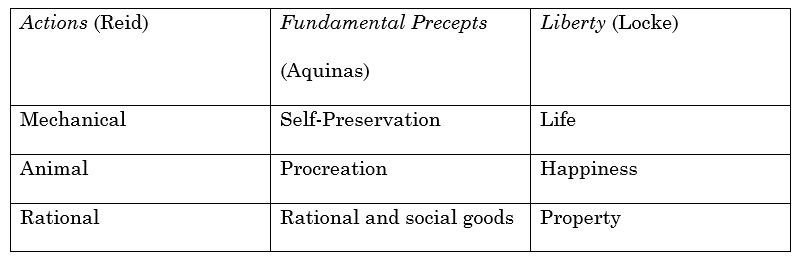
Jefferson’s addition of the words “in pursuit of” before “happiness” draws us to a complementary mathematical principle: differential calculus.[203] While Reid argued against the application of the mathematical tenets for dissecting the complexity of the natural law, none of the natural philosophers, including the founder of utilitarianism, Jeremy Bentham, appears to have applied the concept of differential calculus in their discernment of the natural law.[204] A quick brush-up on basic differential calculus; in mathematics, a derivative is the slope of a point on a graph.[205] A derivative is where the point is tending towards in an equation (usually up or down to some degree).[206] In other words, it is the equation to find where the point is pursuing towards.
By considering the weight and balance of each of the fundamental precepts against one another, as within each category of liberty, we can determine the derivative of an action or inaction. Essentially, whether the action is tending towards or away from liberty. In other words, by testing the weight of the fundamental precepts as applied to the pursuit of happiness, life, or property, we can find the value of the action or inaction, and therefore whether the action or inaction is a natural right.
If the Court first contextualizes the action by categorizing it according to Reid and then attempts to tie the action to a category of liberty by taking the derivative of each liberty category, it can determine whether an action is a fundamental right. In other words, the Court can compare the action to the natural law, and find if the action tends towards or away from moral, or ordered, liberty. From the Presumption of Permissibility, the categorization of action, and the derivative of that action as it pertains to liberty, we can create steps for a Court to follow in asking whether an action or inaction is manifest of a fundamental right. When an issue arises as to whether a state action is violative of a fundamental right, a Court should ask the following:
1. Presume permissibility of the individual’s action or wanted action (whatever is being prevented or mandated by the State).
a. Categorize the individual’s action or inaction to contextualize it properly.
b. Identify the category of Liberty that best fits with the action/inaction’s consequence.
2. Weigh the value of the liberty consequence. (Is the action or inaction in pursuit of any Liberty category?)
a. To weigh, presuming permissibility, apply the trinary matrix from the individual’s perspective:
i. Does the action or inaction promote the self-preservation, procreation, or rational and social good of life?
ii. Does the action or inaction promote the self-preservation, procreation, or rational and social good of happiness?
iii. Does the action or inaction promote the self-preservation, procreation, or rational and social good of property?
b. If yes, it constitutes a permissible Natural Action/Inaction.
c. If no, it fails the Presumption of Permissibility and is therefore regulable.
3. Determine if the Natural Action/Inaction is a Natural Right. (Is the Natural Action/Inaction a Natural Right?)
a. From the perspective of the State, apply the trinary matrix in favor of the collective people of the State. In other words, ensure that the fundamental precepts are in balance with one another.
i. Does the action or inaction eviscerate the self-preservation, procreation, or rational and social good of others' pursuit of life?
ii. Does the action or inaction eviscerate the self-preservation, procreation, or rational and social good of others' pursuit of happiness?
iii. Does the action or inaction eviscerate the self-preservation, procreation, or rational and social good of others' pursuit of property?
b. If yes, then the precepts are unbalanced and the State can regulate the action.
c. If no, the action does not eviscerate the collective others’ pursuit of life, happiness, or property, and it is a fundamental natural right.
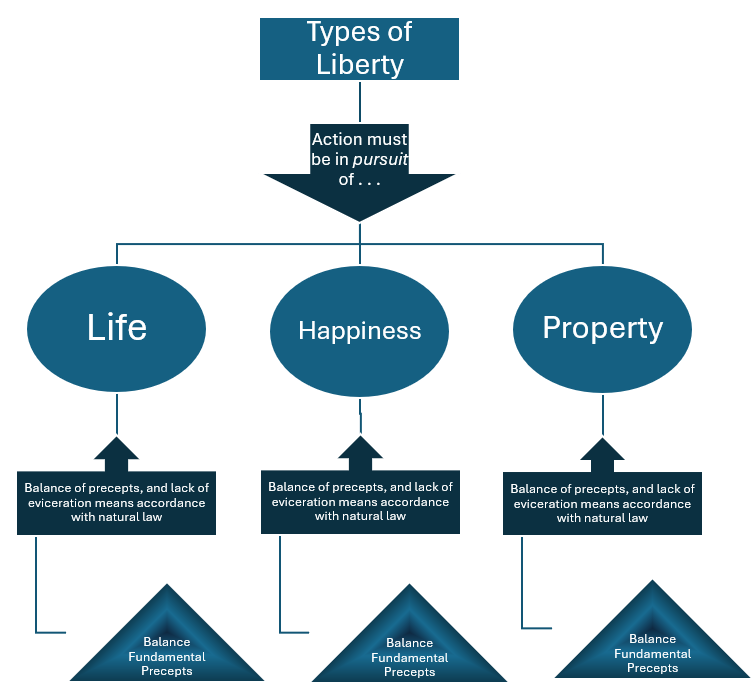
Figure 1 - Relationship between the types of liberty, human action, and the precepts.
Further elaboration on each precept and proper balancing is certainly needed, but for the sake of brevity, this framework of sensus communis has the potential to revive the lost component in modern American law. By defining the steps to enact the Scottish ideas of liberty, the Founders’ original intent is not only understood as it was at the time, but perpetually realized through an adherence to the Scottish principle that knowledge is useless without action. That action, of course, is a flourishing of the pursuit of liberty. For further clarity, Figure 1 demonstrates the relationship between the types of liberty, human action, and the precepts.
Sensus communis satisfies both the textualists and originalists’ misgivings in interpretation and applicability. The textualists can see where the words they set out to interpret originate from, and how clauses and phrases are to be defined. The originalists can see where the history and tradition of constitutional interpretation culminate through the teachings of the Scottish Enlightenment. In the same vein, sensus communis brings originalism to life by mandating the further exploration and enumeration of the natural law, as the Founders intended.
IV. Conclusion
The Sons of Liberty were not taught by the Sons of St. George but by the Sons of England’s most ancient opponent, the Sons of Macbeth. While England kept its eyes on Europe and the New World, the kilt-wearing barbarians of the north, having been relegated to centuries of warfare and cultural hindrance, developed the foundations of the modern world itself, including American law. Scotts would develop the core of the modern university, modern economics, and most importantly, the core of modern political thought and jurisprudence. They did this not in reverence to the English common law, but through a revived understanding of the natural law, that understanding being through the framework of common-sense: sensus communis.
Contemporary American jurisprudence has disconnected from its foundational principles rooted in the "laws of nature and of nature's God", largely due to neglecting the interpretive key of sensus communis. Prevailing interpretive methodologies like Originalism and Textualism face limitations. Influential jurists such as Scalia and Thomas have struggled to establish consistent frameworks for divining fundamental rights, often finding themselves caught between rigid textual analysis and the complex, evolving nature of tradition and general law.
The origins of sensus communis, however, trace back to the Scottish Enlightenment, whose ideas profoundly influenced the American Founders—including Witherspoon, Madison, Wilson, Hamilton, and Jefferson—through figures like Thomas Reid. Common sense, understood as a philosophical method via Reid, allows discernment of self-evident truths and natural law principles through innate moral faculties and moral liberty. A practical Sensus Communis Method, integrating Reid's principles with Aquinas's natural precepts and Lockean/Jeffersonian liberty categories (life, happiness, property), provides a structured approach for evaluating actions and determining the scope of fundamental rights. Though certainly far from being finely tuned, this method, grounded in the Presumption of Permissibility and a balancing of natural inclinations, offers a way to bridge the gap between natural law and positive law, satisfying the aims of both textualists and originalists by connecting interpretation to the demonstrable history and philosophical tradition intended by the Founders. By reviving sensus communis, American jurisprudence can potentially rediscover its anchor in natural law and more faithfully interpret the Constitution as a document securing liberty.
As the lyrics to ‘Scotland the Brave’ prophesied,
“Let Italy boast of her gay gilded waters . . .
Where freedom expires amid softness and sighs . . .
Scotland’s blue mountains wild where hoary cliffs are piled . . .
Land of the misty cloud, land of the tempest loud . . .
Land of the brave and proud, Land of the Free.”[207]
[1] Business Insider, Antonin Scalia Criticizes Law Schools, Business Insider (May 19, 2014), https://www.businessinsider.com/antonin-scalia-criticizes-law-schools-2014-5 (last visited Apr. 27, 2025).
[2] See Adam J. White, Antonin Scalia, Legal Educator, Nat’l Affs. (Fall 2016), https://www.nationalaffairs.com/publications/detail/antonin-scalia-legal-educator.
[3] Id.
[4] Jeff Neal, Was Antonin Scalia Originally an Originalist?, Harv. L. Today (Oct. 26, 2022), https://hls.harvard.edu/today/was-antonin-scalia-originally-an-originalist/ (last visited Mar. 17, 2025).
[5] Rogers v. Tennessee, 532 U.S. 451, 472 (2001).
[6] Marbury v. Madison, 5 U.S. 137, 177 (1803).
[7] See Mark Walsh, A View from the Courtroom: I’m Scalia and Other Quips, SCOTUSBLOG (Feb. 18, 2016, 12:00 AM), https://www.scotusblog.com/2016/02/a-view-from-the-courtroom-im-scalia-and-other-quips/ (last visited Apr. 27, 2025) (detailing notes about Scalia’s common sense remarks); Bruce Frohnen, Judge Gorsuch and the Loss of Our Common Mind, THE IMAGINATIVE CONSERVATIVE (Feb. 7, 2017), https://theimaginativeconservative.org/2017/02/judge-neil-gorsuch-loss-common-mind-bruce-frohnen.html (last visited Apr. 27, 2025) (claiming Gorsuch to be as common sense as Scalia).
[8] White, supra note 2.
[9] Id.
[10] Id.
[11] Id.
[12] See McDonald v. City of Chicago, Ill., 561 U.S. 742, (2010); TransUnion LLC v. Ramirez, 594 U.S. 413 (2021).
[13] McDonald 561 U.S. at 806.
[14] Id. at 767.
[15] Id. at 750.
[16] Id. at 758.
[17] Id.
[18] Id. at 811.
[19] Id.
[20] Id.
[21] McDonald, 561 U.S. at 811. See New York State Rifle & Pistol Ass'n, Inc. v. Bruen, 597 U.S. 1 (2022).
[22] TransUnion, 594 U.S. at 413.
[23] Id.
[24] Id.
[25] Id. at 436.
[26] Id. at 425.
[27] Id.
[28] Id. at 441.
[29] Id. at 442
[30] Id.
[31] Id. at 444.
[32] Id. at 444 (internal quotations omitted).
[33] Id.
[34] Id at 445.
[35] Id.
[36] Id.
[37] Id. at 445-46.
[38] Id. at 446.
[39] Id.
[40] Id.
[41] Id. at 447.
[42] Id. at 447-48.
[43] Id. at 450.
[44] Id. (internal quotations omitted).
[45] Id.
[46] Id. at 451.
[47] Id. at 452-53.
[48] Id. at 453.
[49] Id.
[50] Id. at 458.
[51] Id. at 549.
[52] Jud Campbell, Tradition, Originalism, and General Fundamental Law, 47 Harv. J.L. & Pub. Pol'y 635, 638–39 (2024).
[53] Id. at 642–43.
[54] Id.
[55] Id. at 649.
[56] Id. at 650.
[57] Id.
[58] Id. at 650–51.
[59] Id. at 644.
[60] Id. at 644–645.
[61] Id. at 645.
[62] Id.
[63] Id. at 650.
[64] Id. at 649.
[65] Id. at 646.
[66] Id. at 650.
[67] Id. at 656.
[68] Id. at 651.
[69] Id.
[70] Id. at 652.
[71] Id.
[72] Id.
[73] Id. at 655.
[74] Id.
[75] Id.
[76] TransUnion, 594 U.S. at 549.
[77] McDonald, 561 U.S. at 758.
[78] Neal, supra note 4.
[79] Jud Campbell, The History of Natural Law in American Law Transcript, CIT (last visited Apr. 27, 2025), https://cit.catholic.edu/the-history-of-natural-law-in-american-law-transcript/.
[80] Id.
[81] William Baude, Jud Campbell & Stephen E. Sachs, General Law and the Fourteenth Amendment, 76 Stan. L. Rev. 1185, 1193–94 (2024).
[82] Id. at 1195.
[83] Id. at 1196.
[84] Id.
[85] Id. at 1197.
[86] Id. at 1197–98.
[87] Id.
[88] Id. at 1198.
[89] McDonald, 561 U.S. at 874.
[90] John O. McGinnis, A Dialogue Between Originalism and Natural Law?, Law & Liberty (last visited Apr. 27, 2025), https://lawliberty.org/book-review/a-dialogue-between-originalism-and-natural-law/.
[91] Arthur Herman, How the Scots Invented the Modern World: The True Story of How Western Europe's Poorest Nation Created Our World & Everything in It 229 (Crown Publishing Group, 2001).
[92] Id. at 246, 251 ,264.
[93] See id. 229–266.
[94] Id. at 242.
[95] Id. at 243.
[96] Id.
[97] Id. at 244.
[98] Id.
[99] Id. at 248-249.
[100] Id. at 245.
[101] Id. at 260.
[102] Id. at 260-61.
[103] Id. at 261.
[104] Id.
[105] Id.
[106] Id. at 264.
[107] Id.
[108] Id. at 265.
[109] Id.
[110] Id.
[111] Id. at 262.
[112] Id.
[113] Id. at 263.
[114] The Federalist No. 1 (Alexander Hamilton).
[115] Thomas Reid, Essays on the Intellectual Powers of Man (1785), Essay VII: “Reasoning,” https://www.earlymoderntexts.com/assets/pdfs/reid1785essay7.pdf.
[116] Herman, supra note at 263.
[117] Id.
[118] Id.
[119] Id.
[120] Id.
[121] Id. at 254.
[122] Herman, supra note at 254; David S. Clark, Comparative Law in the United States: Development from the 19th Century to Today 51 (Oxford Univ. Press 2023); Gillian Hull, William Small 1734–1775: No Publications, Much Influence, 90 J. Royal Soc’y Med. 102 (1997), https://journals.sagepub.com/doi/pdf/10.1177/014107689709000214 .
[123] William Walker, Professor William Small 1734–1775, Coll. of William & Mary (last visited Apr. 28, 2025), https://www.wm.edu/as/physics/about_physics/williamsmall/.
[124] Monticello, William Small, Monticello (Sept. 6, 2009), https://www.monticello.org/research-education/thomas-jefferson-encyclopedia/william-small/ (last visited Apr. 28, 2025).
[125] Hull, supra note 122.
[126] Letter from Thomas Jefferson to William Small (May 7, 1775), in 1 The Papers Of Thomas Jefferson 165–67 (Julian P. Boyd ed., Princeton Univ. Press 1950), https://founders.archives.gov/documents/Jefferson/01-01-02-0103.
[127] Herman, supra note at 266.
[128] See Reid, supra note 115.
[129] Id.
[130] James Wilson, Lectures on Law, Of the Study of the Law in the United States, in Collected Works of James Wilson 500–525 (Bird Wilson ed., Phila., 1804).
[131] Ryan Nichols & Gideon Yaffe, Thomas Reid, Stan. Encyclopedia Phil. (Edward N. Zalta & Uri Nodelman eds., Summer 2023 ed.), https://plato.stanford.edu/archives/sum2023/entries/reid/ (last visited Mar. 17, 2025).
[132] Id.
[133] Id.
[134] Id.
[135] Peter Wirzbicki, John Witherspoon, the Scottish Common Sense School, and American Political Philosophy, 80 Theology Today 4 (Jan. 12, 2024), https://doi.org/10.1177/00405736231207542.
[136] Reid, supra note 115 at 291.
[137] Id. at 292.
[138] Id. at 303–305.
[139] Id.
[140] Id.
[141] See id. at 291 (“Moral obligations depend on the constitution [nature] has given [humans] and the circumstances in which he has placed them... Virtue is the business of all men, and its first principles are written in their hearts”).
[142] Id.
[143] Wilson, supra note 130 at 525.
[144] Id. at 500–525.
[145] See Bethel v. New York City Transit Auth., 92 N.Y.2d 348 (1998); Vaughan v. Menlove, 132 Eng. 490 (1837); Bjorndal v. Weitman, 344 Or. 470, 184 P.3d 1115 (2008). Cases demonstrate the use of the reasonable person standard.
[146] Hinson v. Maryland Transit Admin. (MTA) Rail, No. CV DKC 16-0792, 2017 *3 WL 6055447 (D. Md. Dec. 6, 2017).
[147] Stephens Law Firm, What is Considered a "Reasonable Person" When it Comes to Negligence?, Stephens Law Firm (July 16, 2021), available at https://www.stephenslaw.com/blog/what-is-considered-a-reasonable-person-when-it-comes-to-negligence/1.
[148] Id.
[149] Reid, supra note 115 at 293; Wirzbicki, supra note 135.
[150] Wirzbicki, supra note 135.
[151] Id.
[152] Reid, supra note 115 at 292-93. Reid asserts that first principles of morals must be immediately known, otherwise we have no foundation on which others can rest. These principles-such as the duty to promote communal good, keep promises, and avoid harm-are intuitive and derived from human nature and divine will. He emphasizes that a law-maker’s duty to promote the good of the community is self-evident and requires no demonstration. This implies that positive laws (human-made laws) must align with these innate moral truths.
[153] Wirzbicki, supra note 135.
[154] Reid, supra note 115 at 290–91.
[155] Id.
[156] Id. at 292–93.
[157] Thomas Reid, Essays On The Active Powers Of Man 166, 173 (Early Modern Texts ed., 2017) (“We are social creatures whose happiness or misery is strongly connected with that of our fellow-men. Our constitution includes many benevolent affections, the exercise of which makes a large part of our good and enjoyment-by virtue of which this principle leads us by a different and more indirect route to the practice of justice, humanity, and all the social virtues.” “In all testimony, in all promises, and in all contracts, there is necessarily implied a moral obligation on one party and in the other a trust based on this obligation.”).
[158] Id. at 166.
[159] Id. at 115.
[160] Nichols & Yaffe, supra note 131.
[161] Herman, supra note at 261.
[162] Id.
[163] Herman, supra note at 262.
[164] Thomas Reid, An Inquiry Into The Human Mind 14 (2017) (Early Modern Texts ed., 2017).
[165] Id. at 17.
[166] See Reid, supra note 155 at 24.
[167] See id. at 412.
[168] Herman, supra note at 262.
[169] Id.
[170] Nichols & Yaffe, supra note 131.
[171] Id.
[172] Id.
[173] Id.
[174] Id.
[175] Id.
[176] Id.
[177] Id.
[178] Id.
[179] Id.
[180] Id.
[181] Id.
[182] See Reid, supra note 157 at 7 (“Everyone must acknowledge that to act properly is much more valuable than to think soundly or to reason sharply.”).
[183] Wilson, supra note 135 at 438.
[184] Herman, supra note at 258.
[185] Id.
[186] Id. at 259.
[187] The Federalist No. 51 (James Madison) (“Ambition must be made to counteract ambition.”).
[188] Herman, supra note at 264.
[189] Id.
[190] Id. at 266.
[191] Id.
[192] James Moore, Natural rights in the Scottish Enlightenment, The Cambridge History of Eighteenth-Century Political Thought 291, 306 (Mark Goldie & Robert Wokler eds., Cambridge Univ. Press, 2006).
[193] Id.
[194] See Reid, supra note 157 at 9 (discussing that the attempt to find the complexity of an idea undermines its simplicity).
[195] Thomas Aquinas, Summa Theologiae I-II, q. 94, a. 2.
[196] Id.
[197] Id.
[198] Id.
[199] See Stephen Braren, The Evolution of Social Connection as a Basic Human Need https://www.thesocialcreatures.org/thecreaturetimes/evolution-of-social-connection (May 24, 2025).
[200] Id
[201] Id.
[202] Id.
[203] Declaration of Independence para. 2 (U.S. 1776).
[204] See Philip Schofield, Utility And Democracy: The Political Thought Of Jeremy Bentham 75 (Oxford Univ. Press 2006) (applying basic arithmetic to moral questions).
[205] See Derivatives: definition and basic rules, Khan Acad., https://www.khanacademy.org/math/differential-calculus/dc-diff-intro (last visited Apr. 29, 2025) (The derivative is the slope of the tangent line to the graph at that point, or the instantaneous rate of change of the function).
[206] See id.
[207] John Charles McDermott, Scotland The Brave (adapt. of James Hyslop, Let Italy Boast (1821)) (emphasis added).